In British Columbia, municipalities are required by the Province of BC to finalize their budgets before May 15 of each year. Creating a municipal budget is a balancing act between the community’s wants and needs and costs to the taxpayer.
The City’s 2026 budget development process is underway. At various public Council and Committee of the Whole meetings over the past few months, Council has reviewed and analyzed the individual department budgets for the City. Residents are invited to attend an upcoming meeting to follow along:
Date | Budget topics | Meeting type |
January 26, 2026, 4:00 – 5:00 pm | Overview of how municipal budgeting works and what is included in the proposed 2026 budget | Community information meeting* |
February 9, 2026, 2:00pm (no set end time) | Review of 2026 operating and capital budgets | Committee of the Whole meeting* |
March 9, 2026, 2:00 pm (no set end time) | Review distribution between residential and commercial properties, and set 2026 tax rates | Committee of the Whole meeting* |
April 13, 2026
6:00pm (no set end time) | Three Readings of Tax Rate Bylaw and Five Year Financial Plan Bylaw | Council Meeting* |
April 27, 2026
6:00pm (no set end time) | Adoption of Tax Rate Bylaw and Five Year Financial Plan Bylaw | Council Meeting * |
*All meetings take place at City Hall, 200 Craig St.
The agendas for the Committee of the Whole meetings are posted here in advance of each meeting.
What are City Council’s spending priorities for 2026?
In 2026, the City’s budget includes a proposed tax increase of 8.73%.
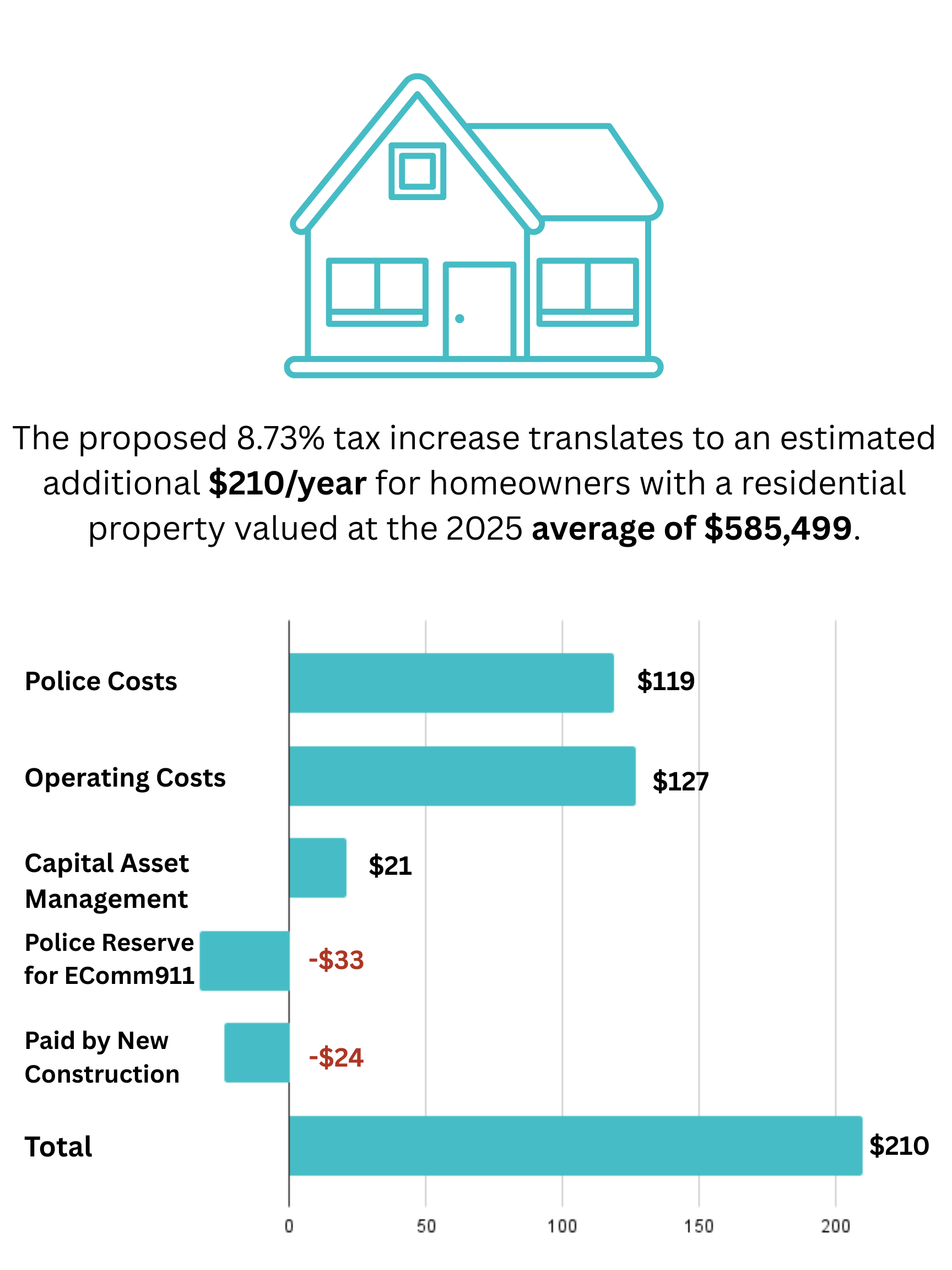 | The table below summarizes the tax increases included in the City’s draft 2026 budget:
|
| % increase | $ increase | Police Costs (see table below) | 4.93% | $355,088 | Operating Costs | 5.28% | $379,897 | Capital Asset Management (half of recommended 1.75% tax increase) | 0.875% | $63,007 | Use of police reserves for smoothing EComm911 costs | -1.36% | (-$97,680) | Total increase | 9.73% | $700,312 | Paid for by new construction | -1.00% | (-$70,242) | Total increase to be paid by existing taxpayers | 8.73% | $630,070 |
|
There is a detailed breakdown of the items included in the 2025 budget further below on this page.
If you would like to read more about the proposed budget, please review the reports contained in the November 3, 2025 and November 24, 2025 Committee of the Whole meetings.
Why are policing costs going up by 4.93%?
In British Columbia, the provincial government is responsible for providing policing and law enforcement to municipalities with a population of under 5,000. In 2021, the City’s population surpassed 5,000. Under the BC Police Act, this required the City to pay for 70% of its policing costs starting in 2022, with the federal government paying the remaining 30%. The provincial government is responsible for determining how many police officers are required for the City, and the federal government is responsible for setting the police budgets. Based on the number of calls for service in this area, the provincial government required the City to fund eight officers in 2022, increasing by one officer each year until reaching 12 officers in 2026. The City must also contribute proportionally to the operating costs of the North Cowichan/Duncan RCMP detachment building, administration, and equipment. | 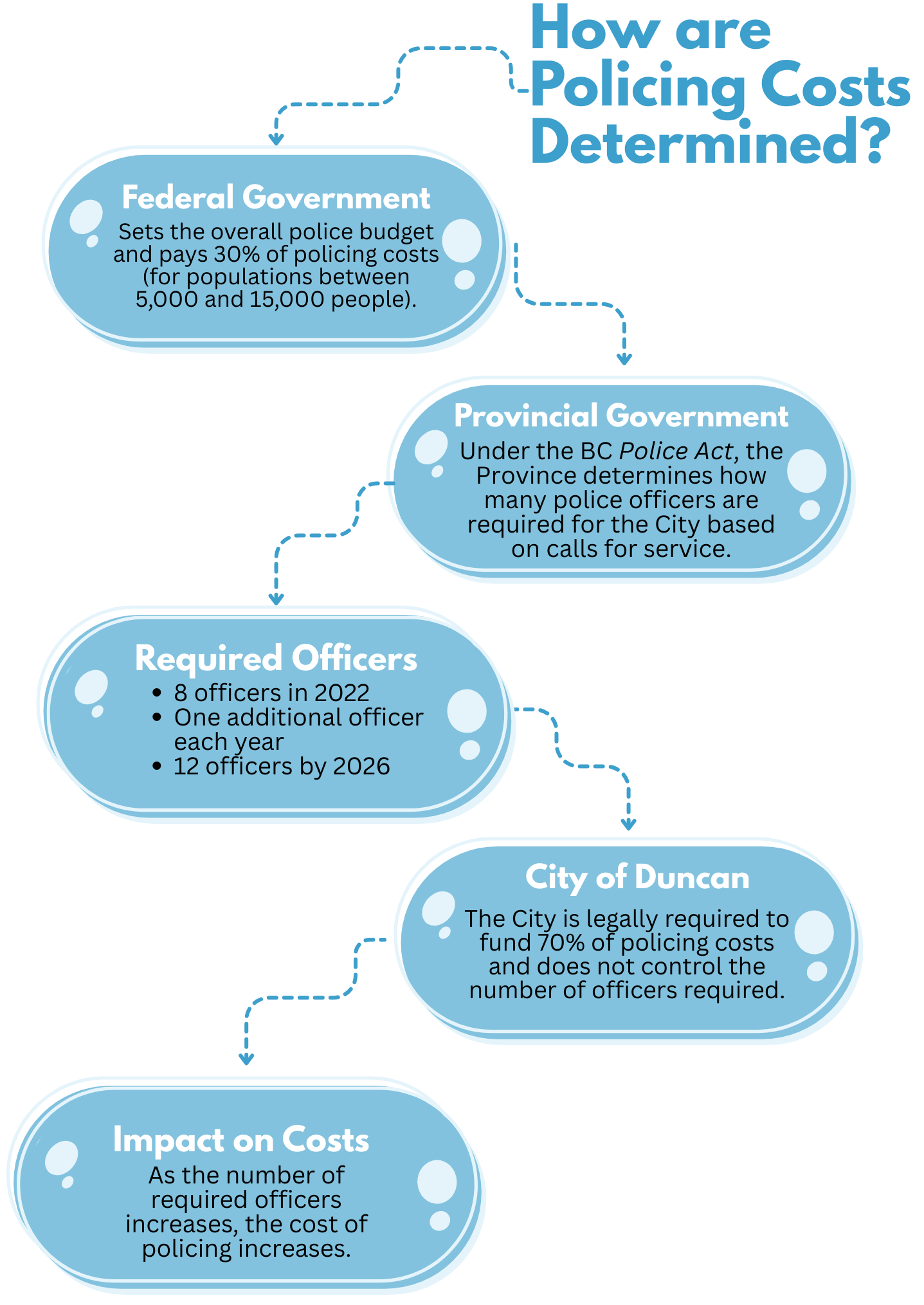 |
The table below illustrates how the City’s policing costs have evolved:
| 2022 | 2023 | 2024 | 2025 Budget | 2026 Budget |
Cost of 8 officers (budgeted for 100% of member staffing cost for 9 months) | $935,176 |
|
|
|
|
Cost of 9 officers (budgeted for 90% of staffing cost for full year) |
| $1,322,543 |
|
|
|
Cost of 10 officers (budgeted for 90% of member staffing cost) |
|
| $1,458,125 |
|
|
Cost of 11 officers (budgeted for 90% of member staffing cost) Cost of Ecomm911 for 9 months |
|
|
| $1,688,060 $287,450 |
|
Cost of 12 officers (draft budget is for 80% of member staffing cost) Cost of Ecomm911 for full year |
|
|
|
| $1,722,083
$296,000 |
Other related police expenses – support staff, building costs, IT support, crime analyst, keep of prisoners. | $321,578 | $528,770 | $729,750 | $1,006,614 | $993,727 |
Restorative Justice Restorative Justice paid from general surplus |
|
| $4,000
($4,000) | $4,000 | $4,152 |
Amount used from reserves | (-$75,000) | (-$240,000) | (-$225,000) | (-$37,800) (-$287,450) | (-$97,680) |
Amount collected from property owners through taxation | $1,181,754 | $1,611,313 | $1,962,875 | $2,660,874 | $2,918,282 |
Actual costs | $875,308 | $1,233,135 | $1,845,570 | TBD | TBD |
Deposit to Police Reserve | $381,446 | $618,178 | $346,305 | TBD | TBD |
Why are we paying EComm911 costs?
Historically, RCMP-policed South Island municipalities received dispatch services through the Provincial Operational Communications Centre (OCC) at the West Shore Detachment. Costs were fully covered under a 70/30 funding model between the Province and the federal government.
The Province has collaborated with local law enforcement jurisdictions to consolidate dispatch services for the Capital Region and the South Island and selected E-Comm as the service provider. The expectation was that the original funding model was to remain unchanged, but we learned that the City was required to pay these costs beginning in April 2025. The estimated cost for one year of EComm911 service for the City of Duncan is $295,000 (that’s a 4% tax increase).
In order to smooth out the additional EComm911 costs, City Council voted to pay the entire 2025 cost from the police reserve fund, and pay 1/3 of the 2026 cost from the police reserve fund. This does not eliminate the tax increase, but rather pushes it forward to the next year.
What else is included in the 2026 budget?
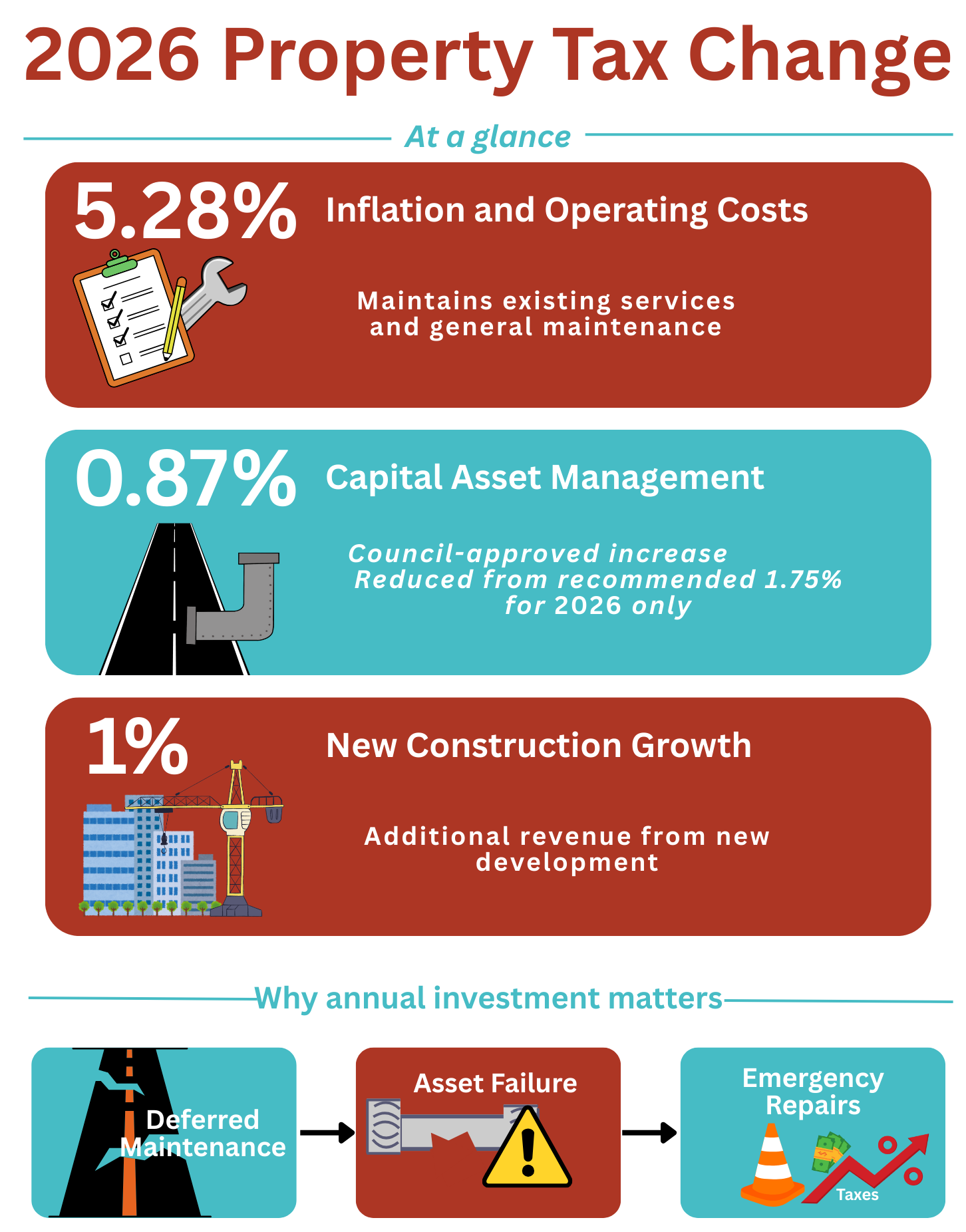 A 5.28% increase has been drafted to address inflation and increased operating costs. Inflation requires an increase in taxes, just to keep paying for general maintenance budgets.
A 1.75% increase has been recommended to address capital asset management and replacement. Municipal assets are publicly owned infrastructure that municipalities are responsible for managing, such as roads, water pipes, parks, sewage collection systems, vehicle and equipment fleets, and more. If taxes are not increased each year to account for inflation, the City would have to reduce maintenance budgets or defer major capital works. This could result in the failure of an asset, which then would require higher future taxes to pay for emergency repairs or replacement. Eventually the deferred major capital works must be done, which would again result in higher future taxes to do the works that should have been done. City Council voted to reduce the recommended increase by half and only do an increase of 0.87% for 2026 only, to keep the tax increase lower.
1% of additional tax revenue is a result of new construction within city limits. New construction increases property tax revenues by expanding the tax base and adding new properties to the tax roll. As more valuable properties are built, the City receives additional funds that help support public services and infrastructure.
If the property tax increase is 8.73%, will my property taxes go up by 8.73%?
An increase or decrease in your property assessment does not mean your taxes will automatically go up or down by the same amount.
In January, property assessment notices are mailed annually to property owners throughout the province from BC Assessment, an independent agency created by the Provincial Government for the purpose of valuing all properties in BC for taxation purposes. Your assessment notice estimates the market value of your property as of July 1 of the previous year.
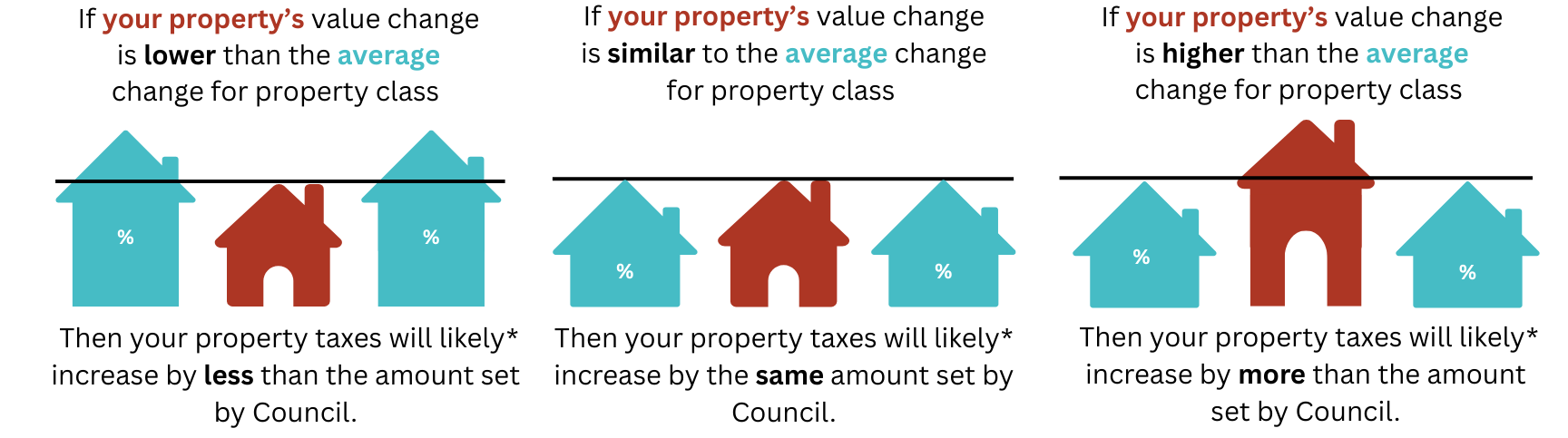
*The diagram above assumes no changes in the distribution of tax allocation between classes and no changes in tax amounts for other jurisdictions.
Watch this short video from BC Assessment (external link) to learn more.
Where does the City get its revenue?
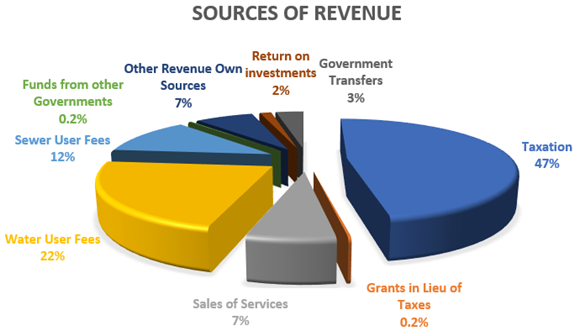
| Own Sources Include: - Business and dog licences
- Building and related permits
- Real estate rentals
- Parking permits
- Interest on investments
- Penalties
- Grants
Sales of Services include: - Garbage and recycling fees
- Fire Protection fees
- Administration fees
- Sports field user fees
- Utilities connection fees
|
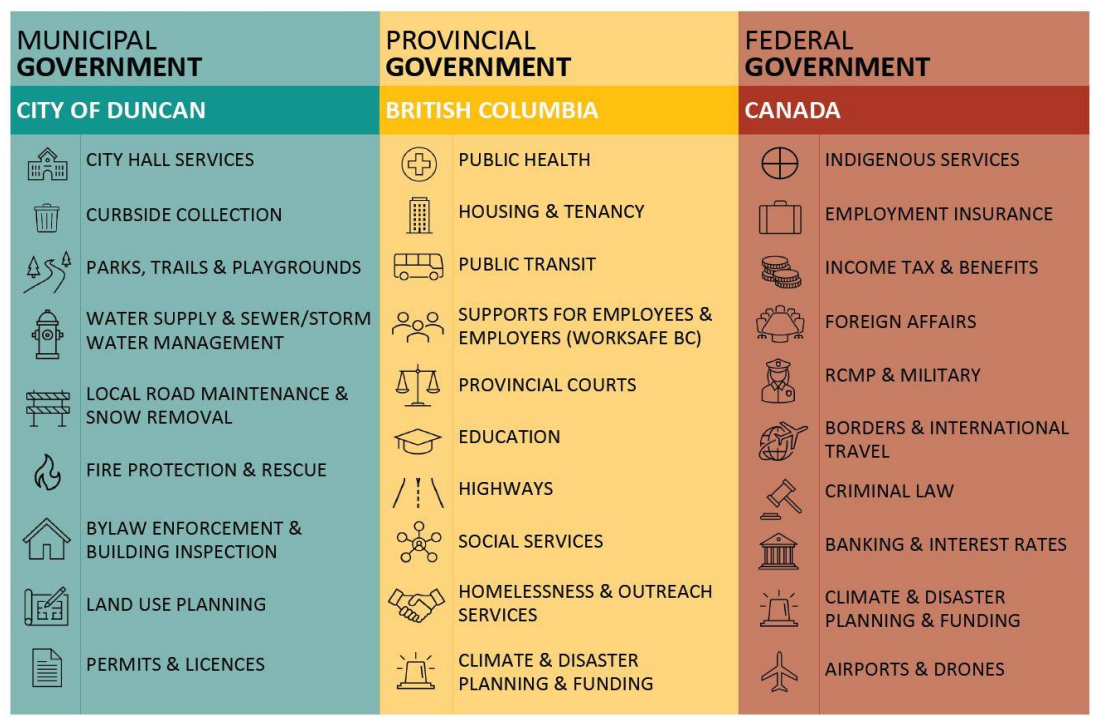
What services does the City provide?
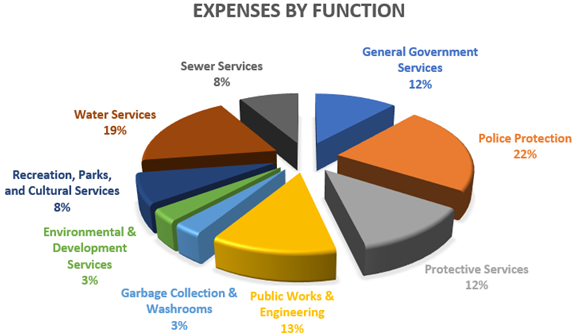
City Expenses:
What are the major changes in the 2026 budget compared to 2025?
The increase is comprised of the following changes:
REVENUES: |
260 White Road Provincial Govt grant in lieu of taxes- increase in value of building | $14,600 |
Traffic fine revenue sharing increased from 30,000 to 46,000 per year | $16,000 |
Provincial Govt parking lot lease - increased revenue | $10,537 |
Interest revenue - increase due to high rates and high reserves | $43,700 |
Tax penalties - based on history - increase to revenue | $8,000 |
Increase to PW admin charges. As PW costs increase, so does the admin fee to water & sewer, this is a revenue line to PW. | $29,167 |
Increase to admin department fees from water and sewer, as administration expenses increase, so does the charge to water and sewer. This is a revenue line to admin. | $28,258 |
EXPENSES: |
Police protection and accommodation - member cost increase from 11 officers to 12 officers, less accommodation costs which have decreased slightly, add EComm911 | $317,288 |
Fund 1/3 of EComm911 costs from police reserve | (-$97,680) |
Previous police costs paid from reserves - now must be made up | $37,800 |
Fire dept expense increases ($113,734 less 49% pd by partners) | $58,004 |
Increase in library requisition | $25,119 |
Increase in Council pay as per bylaw | $9,800 |
Increase in Council travel and conference expenses | $11,570 |
Fund portion of Council travel from reserve | (-$6,500) |
Addition of Duncan North Cowichan Sports Wall of Fame | $3,500 |
Increase in parking software expense | $6,400 |
Addition of 3 month term maintenance worker | $26,000 |
Increase to general equipment reserve contribution, for various equipment | $12,000 |
Increase to fire dept equipment reserve contribution, for various borrowing repayment - 22,965 less 49% pd by partners | $11,712 |
50% of City Planner salary now coming from taxes and 50% from Planning & Building reserve. Previous years was 25% from taxes, 75% from reserve | $38,200 |
Increase in contribution to capital: 3% increase over last year for inflation | $25,158 |
Increase in contribution to capital: half of 1.75% increase in taxation for asset management plan | $63,007 |
Increase to operating wages (union and exempt) | $227,827 |
MISC SMALL EXPENSES: |
Admin training | $2,650 |
IT software and support | $5,500 |
City Hall maintenance | $3,600 |
Office, advertising, postage | $5,475 |
Liability insurance / deductible | $5,000 |
Engineering expenses | $4,120 |
Workshop and yard | $3,600 |
Snow removal | $6,000 |
Weed control | $5,000 |
Boulevards | $3,900 |
Totem maintenance | $1,700 |
Homeless encampment clean up | $3,000 |
McAdam park washrooms | $2,800 |
Rotary Park | $6,000 |
Litter baskets | $4,800 |
Misc other expense and revenue fluctuations | $18,224 |
|
|
Total increase to tax collected for 2026 | $700,312 |
Contribution from new construction | (-$70,242) |
Total increase to be paid by existing taxpayers | $630,070 |
How to read your property tax bill
Property tax bills are mailed out every year in June and taxes are legislatively required to be paid on July 2nd of each year.
Approximately 55% of the money collected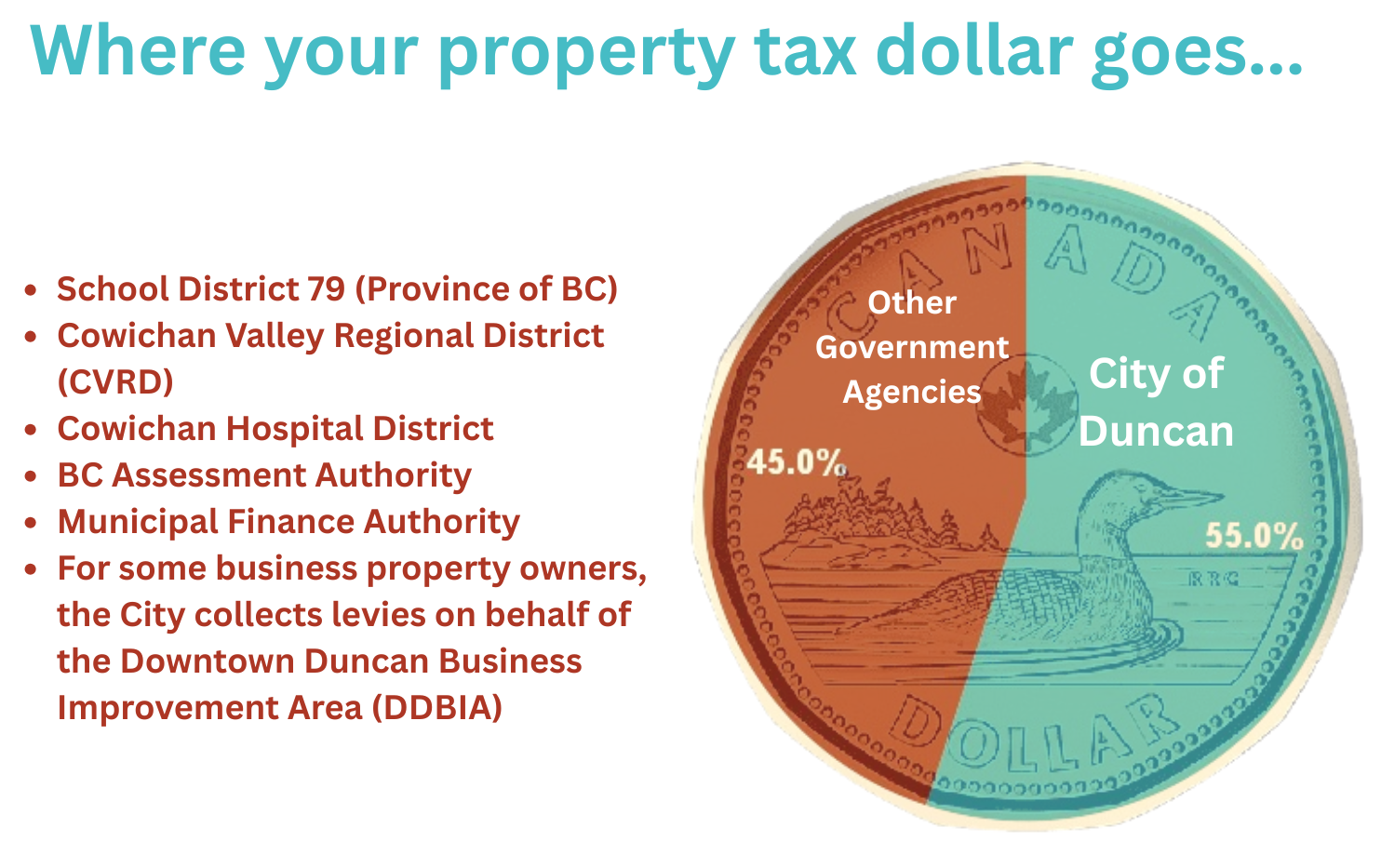 through local taxes goes to the City of Duncan, and 45% goes to other governments and agencies.
The City collects taxes on behalf of these bodies, but does not set their rates or control their dollar amounts.
In addition, most property tax bills currently include the annual sewer charges, although sewer charges are user fees not taxes. The City is working on implementing a changeover to move the sewer charges over to the water bills.
Tax Rates Background
On January 1, 2026, BC Assessment released the Completed Roll showing the average residential assessment increased by 4.61%, while the average commercial assessment increased by just 0.29% over 2025. The Revised Roll will be issued April 1, 2026 and will reflect any changes resulting from appeals.
Residential assessments have historically experienced greater volatility, including a significant spike in 2022 (33%), whereas commercial assessments have generally been more stable with lower growth in recent years. Because residential values are increasing faster than commercial values in 2026, the tax burden will naturally shift toward homeowners unless Council adjusts the commercial-to-residential tax multiple.
The trend of assessment increases:
Year | Average Residential Assessment | Increase (decrease) in Assessment | Average Commercial Assessment | Increase (decrease) in Assessment |
2004 | $131,801 |
| $255,369 |
|
2005 | $160,059 | 21.44% | $270,294 | 5.84% |
2006 | $184,623 | 15.35% | $277,786 | 2.77% |
2007 | $221,669 | 20.07% | $335,356 | 20.72% |
2008 | $258,237 | 16.50% | $373,513 | 11.38% |
2009 | $256,116 | (0.82%) | $372,344 | (0.31%) |
2010 | $261,722 | 2.19% | $381,910 | 2.57% |
2011 | $272,404 | 4.08% | $408,211 | 6.89% |
2012 | $273,988 | 0.58% | $413,508 | 1.30% |
2013 | $264,480 | (3.47%) | $412,817 | (0.17%) |
2014 | $251,577 | (4.88%) | $429,069 | 3.94% |
2015 | $249,060 | (1.00%) | $438,937 | 2.30% |
2016 | $257,027 | 3.20% | $436,169 | (0.63%) |
2017 | $273,984 | 6.60% | $455,746 | 4.49% |
2018 | $316,788 | 15.62% | $527,559 | 15.76% |
2019 | $357,026 | 12.70% | $548,372 | 3.95% |
2020 | $378,799 | 6.18% | $622,982 | 14.01% |
2021 | $399,305 | 5.42% | $656,715 | 5.5% |
2022 | $533,361 | 33.57% | $760,994 | 15.88% |
2023 | $606,717 | 13.75% | $793,378 | 4.26% |
2024 | $573,051 | (5.55%) | $801,482 | 1.02% |
2025 | $585,499 | 2.16% | $823,175 | 3.27% |
2026 | $612,480* *(completed roll) | 4.61% | $825,522* *(completed roll) | 0.29% |
Analysis
When setting tax rates, the City can use the multiple to smooth fluctuations between property classes. In 2025, Duncan’s multiple was 2.9813, meaning the commercial tax rate was roughly three times the residential rate. Municipalities cannot shift taxes within residential subclasses; adjustments can only be made between residential, commercial, and utility classes.
The City of Duncan has a Policy Statement that says “City Council considers the current proportions of taxes collected and current assessment class multiples as reasonable; however as opportunities arise, Council will attempt to lower the percentage of taxes collected from the business class and attempt to hold or lower the business class multiple with a goal to have a multiple at the 50th percentile of other municipalities (median)”.
The City of Duncan history of tax rates and multiples:
Year | Average Residential Assessment | Average Commercial Assessment | Residential Tax Rate | Commercial Tax Rate | Commercial Multiple |
2004 | $131,801 | $255,369 | 4.5721 | 13.1678 | 2.88 |
2005 | $160,059 | $270,294 | 3.9526 | 13.12225 | 3.32 |
2006 | $184,623 | $277,786 | 3.6274 | 12.8410 | 3.54 |
2007 | $221,669 | $335,356 | 3.1728 | 10.9143 | 3.44 |
2008 | $258,237 | $373,513 | 2.9136 | 10.0314 | 3.44 |
2009 | $256,116 | $372,344 | 3.5867 | 11.7860 | 3.29 |
2010 | $261,722 | $381,910 | 3.9280 | 12.7544 | 3.25 |
2011 | $272,404 | $408,211 | 4.2067 | 13.0019 | 3.09 |
2012 | $273,988 | $413,508 | 4.0023 | 12.0930 | 3.02 |
2013 | $264,480 | $412,817 | 4.2397 | 12.2569 | 2.89 |
2014 | $251,577 | $429,069 | 4.5736 | 12.0848 | 2.64 |
2015 | $249,060 | $438,937 | 4.7436 | 11.9522 | 2.52 |
2016 | $257,027 | $436,169 | 4.7623 | 12.0209 | 2.52 |
2017 | $273,984 | $455,746 | 4.5553 | 11.4989 | 2.52 |
2018 | $316,788 | $527,559 | 4.0553 | 10.2355 | 2.52 |
2019 | $356,721 | $547,146 | 3.7238 | 10.2030 | 2.74 |
2020 | $378,799 | $622,982 | 3.6029 | 9.2068 | 2.56 |
2021 | $399,305 | $656,715 | 3.5273 | 9.0137 | 2.56 |
2022 | $533,361 | $760,994 | 3.0589 | 8.9857 | 2.93 |
2023 | $606,717 | $793,378 | 2.9684 | 9.5148 | 3.20 |
2024 | $573,051 | $801,482 | 3.3854 | 10.1453 | 2.99
|
2025 | $585,499 | $823,175 | 3.6814 | 10.9754 | 2.98 |
The most recent (2025) median of all BC municipalities is a multiple of 2.6599.
Council considered the following options:
Option A – Move to BC Median (2.6599 multiple)
| Option B – Equal Percentage Increase (3.1095 multiple)
|
- Residential tax rate: 4.1407
- Commercial tax rate: 11.0141
- Average residential home increase of $380 per year (17.66%)
- Average commercial increase of $57 per year (0.64%)
| - Residential tax rate of 3.8944
- Commercial tax rate of 12.1093
- Average residential home municipal tax increase of $229 (10.66%)
- Average commercial municipal tax increase of $961 (10.65%)
|
Because residential assessments increased significantly more than commercial, moving to the median shifts tax burden heavily to homeowners.
| This achieves the goal of equal percentage increase, however a multiple of 3.1095 is moving further away from the goal of a median at 2.6599.
|
Regional Context
2025 RESIDENTIAL TAX RATES |
| Municipal Rate | CVRD Rate | Total Local Government Levies |
Duncan | 3.6814 | 1.1901 | 4.8715 |
Ladysmith | 2.9240 | 1.3741 | 4.2981 |
Lake Cowichan | 2.6086 | 1.7222 | 4.3308 |
North Cowichan (South End) | 2.7860 | 1.4913 | 4.2773 |
2025 TAXES PAID BY AVERAGE HOME |
| Assessed Value (2025) | Property Taxes | Parcel Taxes | User Fees | Total |
Duncan | $585,499 | $3,860 | $20 | $992 | $4,872 |
Ladysmith | $721,217 | $4,364 | $821 | $907 | $6,092 |
Lake Cowichan | $653,704 | $4,102 | $675 | $981 | $5,758 |
North Cowichan | $761,839 | $4,391 | $509 | $559 | $5,459 |
2025 TAX COMPARISONS USING DUNCAN AVERAGE VALUE OF $585,499 (e.g. if a house in a neighboring community was worth $585,499, this is what they would pay in municipal taxes) |
| Municipal Rate | Municipal Property Taxes | Other Property Taxes | Municipal Parcel Taxes | Municipal User Fees | Total |
Duncan | 3.6814 | $2,155 | $1,704 | $20 | $992 | $4,871 |
Ladysmith | 2.9240 | $1,712 | $1,831 | $821 | $907 | $5,271 |
Lake Cowichan | 2.6086 | $1,527 | $2,147 | $675 | $981 | $5,330 |
North Cowichan | 2.7860 | $1,631 | $1,880 | $509 | $559 | $4,579 |
2025 COMMERCIAL TAX RATES |
| Municipal Rate | CVRD Rate | Total Rate |
Duncan | 10.9754 | 2.9157 | 13.8911 |
Ladysmith | 9.7187 | 3.3665 | 13.0852 |
Lake Cowichan | 7.3041 | 4.2196 | 11.5237 |
North Cowichan | 7.8822 | 3.8774 | 11.7596 |
2025 MULTIPLE COMPARISONS |
| Residential Rate | Commercial Rate | Multiple |
Duncan | 3.6814 | 10.9754 | 2.98 |
Ladysmith | 2.9240 | 9.7187 | 3.32 |
Lake Cowichan | 2.6086 | 7.3040 | 2.79 |
North Cowichan | 2.7860 | 7.8821 | 2.82 |
Duncan is:
- Above the BC median
- Comparable to neighbours
- Not the highest in the region
* Note that the discussion today is based on the Completed Roll, and the final Revised Roll will be released April 1st, 2026. The assessment numbers could change, particularly if residential property owners are successful in getting their assessments lowered. Staff will recalculate once the Revised Roll is released, and if the calculations are significantly different a report will be brought back to Council for further discussion at that time.
The Committee of the Whole has direct staff to draft the 2026 Tax Rates Bylaw with a commercial tax multiple that achieves an even percentage increase between the average commercial and average residential properties.
NEXT STEPS:
April 13th – Three readings of Tax Rate Bylaw and Five Year Financial Plan Bylaw
April 27th - Adoption of Tax Rate Bylaw and Five Year Financial Plan Bylaw
For further information about property taxes, please contact Bernice Crossman at City Hall in-person at 200 Craig Street, by phone (250-746-6126), or by email (bernice@duncan.ca).
In British Columbia, municipalities are required by the Province of BC to finalize their budgets before May 15 of each year. Creating a municipal budget is a balancing act between the community’s wants and needs and costs to the taxpayer.
The City’s 2026 budget development process is underway. At various public Council and Committee of the Whole meetings over the past few months, Council has reviewed and analyzed the individual department budgets for the City. Residents are invited to attend an upcoming meeting to follow along:
Date | Budget topics | Meeting type |
January 26, 2026, 4:00 – 5:00 pm | Overview of how municipal budgeting works and what is included in the proposed 2026 budget | Community information meeting* |
February 9, 2026, 2:00pm (no set end time) | Review of 2026 operating and capital budgets | Committee of the Whole meeting* |
March 9, 2026, 2:00 pm (no set end time) | Review distribution between residential and commercial properties, and set 2026 tax rates | Committee of the Whole meeting* |
April 13, 2026
6:00pm (no set end time) | Three Readings of Tax Rate Bylaw and Five Year Financial Plan Bylaw | Council Meeting* |
April 27, 2026
6:00pm (no set end time) | Adoption of Tax Rate Bylaw and Five Year Financial Plan Bylaw | Council Meeting * |
*All meetings take place at City Hall, 200 Craig St.
The agendas for the Committee of the Whole meetings are posted here in advance of each meeting.
What are City Council’s spending priorities for 2026?
In 2026, the City’s budget includes a proposed tax increase of 8.73%.
| The table below summarizes the tax increases included in the City’s draft 2026 budget:
|
| % increase | $ increase | Police Costs (see table below) | 4.93% | $355,088 | Operating Costs | 5.28% | $379,897 | Capital Asset Management (half of recommended 1.75% tax increase) | 0.875% | $63,007 | Use of police reserves for smoothing EComm911 costs | -1.36% | (-$97,680) | Total increase | 9.73% | $700,312 | Paid for by new construction | -1.00% | (-$70,242) | Total increase to be paid by existing taxpayers | 8.73% | $630,070 |
|
There is a detailed breakdown of the items included in the 2025 budget further below on this page.
If you would like to read more about the proposed budget, please review the reports contained in the November 3, 2025 and November 24, 2025 Committee of the Whole meetings.
Why are policing costs going up by 4.93%?
In British Columbia, the provincial government is responsible for providing policing and law enforcement to municipalities with a population of under 5,000. In 2021, the City’s population surpassed 5,000. Under the BC Police Act, this required the City to pay for 70% of its policing costs starting in 2022, with the federal government paying the remaining 30%. The provincial government is responsible for determining how many police officers are required for the City, and the federal government is responsible for setting the police budgets. Based on the number of calls for service in this area, the provincial government required the City to fund eight officers in 2022, increasing by one officer each year until reaching 12 officers in 2026. The City must also contribute proportionally to the operating costs of the North Cowichan/Duncan RCMP detachment building, administration, and equipment. | |
The table below illustrates how the City’s policing costs have evolved:
| 2022 | 2023 | 2024 | 2025 Budget | 2026 Budget |
Cost of 8 officers (budgeted for 100% of member staffing cost for 9 months) | $935,176 |
|
|
|
|
Cost of 9 officers (budgeted for 90% of staffing cost for full year) |
| $1,322,543 |
|
|
|
Cost of 10 officers (budgeted for 90% of member staffing cost) |
|
| $1,458,125 |
|
|
Cost of 11 officers (budgeted for 90% of member staffing cost) Cost of Ecomm911 for 9 months |
|
|
| $1,688,060 $287,450 |
|
Cost of 12 officers (draft budget is for 80% of member staffing cost) Cost of Ecomm911 for full year |
|
|
|
| $1,722,083
$296,000 |
Other related police expenses – support staff, building costs, IT support, crime analyst, keep of prisoners. | $321,578 | $528,770 | $729,750 | $1,006,614 | $993,727 |
Restorative Justice Restorative Justice paid from general surplus |
|
| $4,000
($4,000) | $4,000 | $4,152 |
Amount used from reserves | (-$75,000) | (-$240,000) | (-$225,000) | (-$37,800) (-$287,450) | (-$97,680) |
Amount collected from property owners through taxation | $1,181,754 | $1,611,313 | $1,962,875 | $2,660,874 | $2,918,282 |
Actual costs | $875,308 | $1,233,135 | $1,845,570 | TBD | TBD |
Deposit to Police Reserve | $381,446 | $618,178 | $346,305 | TBD | TBD |
Why are we paying EComm911 costs?
Historically, RCMP-policed South Island municipalities received dispatch services through the Provincial Operational Communications Centre (OCC) at the West Shore Detachment. Costs were fully covered under a 70/30 funding model between the Province and the federal government.
The Province has collaborated with local law enforcement jurisdictions to consolidate dispatch services for the Capital Region and the South Island and selected E-Comm as the service provider. The expectation was that the original funding model was to remain unchanged, but we learned that the City was required to pay these costs beginning in April 2025. The estimated cost for one year of EComm911 service for the City of Duncan is $295,000 (that’s a 4% tax increase).
In order to smooth out the additional EComm911 costs, City Council voted to pay the entire 2025 cost from the police reserve fund, and pay 1/3 of the 2026 cost from the police reserve fund. This does not eliminate the tax increase, but rather pushes it forward to the next year.
What else is included in the 2026 budget?
A 5.28% increase has been drafted to address inflation and increased operating costs. Inflation requires an increase in taxes, just to keep paying for general maintenance budgets.
A 1.75% increase has been recommended to address capital asset management and replacement. Municipal assets are publicly owned infrastructure that municipalities are responsible for managing, such as roads, water pipes, parks, sewage collection systems, vehicle and equipment fleets, and more. If taxes are not increased each year to account for inflation, the City would have to reduce maintenance budgets or defer major capital works. This could result in the failure of an asset, which then would require higher future taxes to pay for emergency repairs or replacement. Eventually the deferred major capital works must be done, which would again result in higher future taxes to do the works that should have been done. City Council voted to reduce the recommended increase by half and only do an increase of 0.87% for 2026 only, to keep the tax increase lower.
1% of additional tax revenue is a result of new construction within city limits. New construction increases property tax revenues by expanding the tax base and adding new properties to the tax roll. As more valuable properties are built, the City receives additional funds that help support public services and infrastructure.
If the property tax increase is 8.73%, will my property taxes go up by 8.73%?
An increase or decrease in your property assessment does not mean your taxes will automatically go up or down by the same amount.
In January, property assessment notices are mailed annually to property owners throughout the province from BC Assessment, an independent agency created by the Provincial Government for the purpose of valuing all properties in BC for taxation purposes. Your assessment notice estimates the market value of your property as of July 1 of the previous year.
*The diagram above assumes no changes in the distribution of tax allocation between classes and no changes in tax amounts for other jurisdictions.
Watch this short video from BC Assessment (external link) to learn more.
Where does the City get its revenue?
| Own Sources Include: - Business and dog licences
- Building and related permits
- Real estate rentals
- Parking permits
- Interest on investments
- Penalties
- Grants
Sales of Services include: - Garbage and recycling fees
- Fire Protection fees
- Administration fees
- Sports field user fees
- Utilities connection fees
|
What services does the City provide?
City Expenses:
What are the major changes in the 2026 budget compared to 2025?
The increase is comprised of the following changes:
REVENUES: |
260 White Road Provincial Govt grant in lieu of taxes- increase in value of building | $14,600 |
Traffic fine revenue sharing increased from 30,000 to 46,000 per year | $16,000 |
Provincial Govt parking lot lease - increased revenue | $10,537 |
Interest revenue - increase due to high rates and high reserves | $43,700 |
Tax penalties - based on history - increase to revenue | $8,000 |
Increase to PW admin charges. As PW costs increase, so does the admin fee to water & sewer, this is a revenue line to PW. | $29,167 |
Increase to admin department fees from water and sewer, as administration expenses increase, so does the charge to water and sewer. This is a revenue line to admin. | $28,258 |
EXPENSES: |
Police protection and accommodation - member cost increase from 11 officers to 12 officers, less accommodation costs which have decreased slightly, add EComm911 | $317,288 |
Fund 1/3 of EComm911 costs from police reserve | (-$97,680) |
Previous police costs paid from reserves - now must be made up | $37,800 |
Fire dept expense increases ($113,734 less 49% pd by partners) | $58,004 |
Increase in library requisition | $25,119 |
Increase in Council pay as per bylaw | $9,800 |
Increase in Council travel and conference expenses | $11,570 |
Fund portion of Council travel from reserve | (-$6,500) |
Addition of Duncan North Cowichan Sports Wall of Fame | $3,500 |
Increase in parking software expense | $6,400 |
Addition of 3 month term maintenance worker | $26,000 |
Increase to general equipment reserve contribution, for various equipment | $12,000 |
Increase to fire dept equipment reserve contribution, for various borrowing repayment - 22,965 less 49% pd by partners | $11,712 |
50% of City Planner salary now coming from taxes and 50% from Planning & Building reserve. Previous years was 25% from taxes, 75% from reserve | $38,200 |
Increase in contribution to capital: 3% increase over last year for inflation | $25,158 |
Increase in contribution to capital: half of 1.75% increase in taxation for asset management plan | $63,007 |
Increase to operating wages (union and exempt) | $227,827 |
MISC SMALL EXPENSES: |
Admin training | $2,650 |
IT software and support | $5,500 |
City Hall maintenance | $3,600 |
Office, advertising, postage | $5,475 |
Liability insurance / deductible | $5,000 |
Engineering expenses | $4,120 |
Workshop and yard | $3,600 |
Snow removal | $6,000 |
Weed control | $5,000 |
Boulevards | $3,900 |
Totem maintenance | $1,700 |
Homeless encampment clean up | $3,000 |
McAdam park washrooms | $2,800 |
Rotary Park | $6,000 |
Litter baskets | $4,800 |
Misc other expense and revenue fluctuations | $18,224 |
|
|
Total increase to tax collected for 2026 | $700,312 |
Contribution from new construction | (-$70,242) |
Total increase to be paid by existing taxpayers | $630,070 |
How to read your property tax bill
Property tax bills are mailed out every year in June and taxes are legislatively required to be paid on July 2nd of each year.
Approximately 55% of the money collected through local taxes goes to the City of Duncan, and 45% goes to other governments and agencies.
The City collects taxes on behalf of these bodies, but does not set their rates or control their dollar amounts.
In addition, most property tax bills currently include the annual sewer charges, although sewer charges are user fees not taxes. The City is working on implementing a changeover to move the sewer charges over to the water bills.
Tax Rates Background
On January 1, 2026, BC Assessment released the Completed Roll showing the average residential assessment increased by 4.61%, while the average commercial assessment increased by just 0.29% over 2025. The Revised Roll will be issued April 1, 2026 and will reflect any changes resulting from appeals.
Residential assessments have historically experienced greater volatility, including a significant spike in 2022 (33%), whereas commercial assessments have generally been more stable with lower growth in recent years. Because residential values are increasing faster than commercial values in 2026, the tax burden will naturally shift toward homeowners unless Council adjusts the commercial-to-residential tax multiple.
The trend of assessment increases:
Year | Average Residential Assessment | Increase (decrease) in Assessment | Average Commercial Assessment | Increase (decrease) in Assessment |
2004 | $131,801 |
| $255,369 |
|
2005 | $160,059 | 21.44% | $270,294 | 5.84% |
2006 | $184,623 | 15.35% | $277,786 | 2.77% |
2007 | $221,669 | 20.07% | $335,356 | 20.72% |
2008 | $258,237 | 16.50% | $373,513 | 11.38% |
2009 | $256,116 | (0.82%) | $372,344 | (0.31%) |
2010 | $261,722 | 2.19% | $381,910 | 2.57% |
2011 | $272,404 | 4.08% | $408,211 | 6.89% |
2012 | $273,988 | 0.58% | $413,508 | 1.30% |
2013 | $264,480 | (3.47%) | $412,817 | (0.17%) |
2014 | $251,577 | (4.88%) | $429,069 | 3.94% |
2015 | $249,060 | (1.00%) | $438,937 | 2.30% |
2016 | $257,027 | 3.20% | $436,169 | (0.63%) |
2017 | $273,984 | 6.60% | $455,746 | 4.49% |
2018 | $316,788 | 15.62% | $527,559 | 15.76% |
2019 | $357,026 | 12.70% | $548,372 | 3.95% |
2020 | $378,799 | 6.18% | $622,982 | 14.01% |
2021 | $399,305 | 5.42% | $656,715 | 5.5% |
2022 | $533,361 | 33.57% | $760,994 | 15.88% |
2023 | $606,717 | 13.75% | $793,378 | 4.26% |
2024 | $573,051 | (5.55%) | $801,482 | 1.02% |
2025 | $585,499 | 2.16% | $823,175 | 3.27% |
2026 | $612,480* *(completed roll) | 4.61% | $825,522* *(completed roll) | 0.29% |
Analysis
When setting tax rates, the City can use the multiple to smooth fluctuations between property classes. In 2025, Duncan’s multiple was 2.9813, meaning the commercial tax rate was roughly three times the residential rate. Municipalities cannot shift taxes within residential subclasses; adjustments can only be made between residential, commercial, and utility classes.
The City of Duncan has a Policy Statement that says “City Council considers the current proportions of taxes collected and current assessment class multiples as reasonable; however as opportunities arise, Council will attempt to lower the percentage of taxes collected from the business class and attempt to hold or lower the business class multiple with a goal to have a multiple at the 50th percentile of other municipalities (median)”.
The City of Duncan history of tax rates and multiples:
Year | Average Residential Assessment | Average Commercial Assessment | Residential Tax Rate | Commercial Tax Rate | Commercial Multiple |
2004 | $131,801 | $255,369 | 4.5721 | 13.1678 | 2.88 |
2005 | $160,059 | $270,294 | 3.9526 | 13.12225 | 3.32 |
2006 | $184,623 | $277,786 | 3.6274 | 12.8410 | 3.54 |
2007 | $221,669 | $335,356 | 3.1728 | 10.9143 | 3.44 |
2008 | $258,237 | $373,513 | 2.9136 | 10.0314 | 3.44 |
2009 | $256,116 | $372,344 | 3.5867 | 11.7860 | 3.29 |
2010 | $261,722 | $381,910 | 3.9280 | 12.7544 | 3.25 |
2011 | $272,404 | $408,211 | 4.2067 | 13.0019 | 3.09 |
2012 | $273,988 | $413,508 | 4.0023 | 12.0930 | 3.02 |
2013 | $264,480 | $412,817 | 4.2397 | 12.2569 | 2.89 |
2014 | $251,577 | $429,069 | 4.5736 | 12.0848 | 2.64 |
2015 | $249,060 | $438,937 | 4.7436 | 11.9522 | 2.52 |
2016 | $257,027 | $436,169 | 4.7623 | 12.0209 | 2.52 |
2017 | $273,984 | $455,746 | 4.5553 | 11.4989 | 2.52 |
2018 | $316,788 | $527,559 | 4.0553 | 10.2355 | 2.52 |
2019 | $356,721 | $547,146 | 3.7238 | 10.2030 | 2.74 |
2020 | $378,799 | $622,982 | 3.6029 | 9.2068 | 2.56 |
2021 | $399,305 | $656,715 | 3.5273 | 9.0137 | 2.56 |
2022 | $533,361 | $760,994 | 3.0589 | 8.9857 | 2.93 |
2023 | $606,717 | $793,378 | 2.9684 | 9.5148 | 3.20 |
2024 | $573,051 | $801,482 | 3.3854 | 10.1453 | 2.99
|
2025 | $585,499 | $823,175 | 3.6814 | 10.9754 | 2.98 |
The most recent (2025) median of all BC municipalities is a multiple of 2.6599.
Council considered the following options:
Option A – Move to BC Median (2.6599 multiple)
| Option B – Equal Percentage Increase (3.1095 multiple)
|
- Residential tax rate: 4.1407
- Commercial tax rate: 11.0141
- Average residential home increase of $380 per year (17.66%)
- Average commercial increase of $57 per year (0.64%)
| - Residential tax rate of 3.8944
- Commercial tax rate of 12.1093
- Average residential home municipal tax increase of $229 (10.66%)
- Average commercial municipal tax increase of $961 (10.65%)
|
Because residential assessments increased significantly more than commercial, moving to the median shifts tax burden heavily to homeowners.
| This achieves the goal of equal percentage increase, however a multiple of 3.1095 is moving further away from the goal of a median at 2.6599.
|
Regional Context
2025 RESIDENTIAL TAX RATES |
| Municipal Rate | CVRD Rate | Total Local Government Levies |
Duncan | 3.6814 | 1.1901 | 4.8715 |
Ladysmith | 2.9240 | 1.3741 | 4.2981 |
Lake Cowichan | 2.6086 | 1.7222 | 4.3308 |
North Cowichan (South End) | 2.7860 | 1.4913 | 4.2773 |
2025 TAXES PAID BY AVERAGE HOME |
| Assessed Value (2025) | Property Taxes | Parcel Taxes | User Fees | Total |
Duncan | $585,499 | $3,860 | $20 | $992 | $4,872 |
Ladysmith | $721,217 | $4,364 | $821 | $907 | $6,092 |
Lake Cowichan | $653,704 | $4,102 | $675 | $981 | $5,758 |
North Cowichan | $761,839 | $4,391 | $509 | $559 | $5,459 |
2025 TAX COMPARISONS USING DUNCAN AVERAGE VALUE OF $585,499 (e.g. if a house in a neighboring community was worth $585,499, this is what they would pay in municipal taxes) |
| Municipal Rate | Municipal Property Taxes | Other Property Taxes | Municipal Parcel Taxes | Municipal User Fees | Total |
Duncan | 3.6814 | $2,155 | $1,704 | $20 | $992 | $4,871 |
Ladysmith | 2.9240 | $1,712 | $1,831 | $821 | $907 | $5,271 |
Lake Cowichan | 2.6086 | $1,527 | $2,147 | $675 | $981 | $5,330 |
North Cowichan | 2.7860 | $1,631 | $1,880 | $509 | $559 | $4,579 |
2025 COMMERCIAL TAX RATES |
| Municipal Rate | CVRD Rate | Total Rate |
Duncan | 10.9754 | 2.9157 | 13.8911 |
Ladysmith | 9.7187 | 3.3665 | 13.0852 |
Lake Cowichan | 7.3041 | 4.2196 | 11.5237 |
North Cowichan | 7.8822 | 3.8774 | 11.7596 |
2025 MULTIPLE COMPARISONS |
| Residential Rate | Commercial Rate | Multiple |
Duncan | 3.6814 | 10.9754 | 2.98 |
Ladysmith | 2.9240 | 9.7187 | 3.32 |
Lake Cowichan | 2.6086 | 7.3040 | 2.79 |
North Cowichan | 2.7860 | 7.8821 | 2.82 |
Duncan is:
- Above the BC median
- Comparable to neighbours
- Not the highest in the region
* Note that the discussion today is based on the Completed Roll, and the final Revised Roll will be released April 1st, 2026. The assessment numbers could change, particularly if residential property owners are successful in getting their assessments lowered. Staff will recalculate once the Revised Roll is released, and if the calculations are significantly different a report will be brought back to Council for further discussion at that time.
The Committee of the Whole has direct staff to draft the 2026 Tax Rates Bylaw with a commercial tax multiple that achieves an even percentage increase between the average commercial and average residential properties.
NEXT STEPS:
April 13th – Three readings of Tax Rate Bylaw and Five Year Financial Plan Bylaw
April 27th - Adoption of Tax Rate Bylaw and Five Year Financial Plan Bylaw
For further information about property taxes, please contact Bernice Crossman at City Hall in-person at 200 Craig Street, by phone (250-746-6126), or by email (bernice@duncan.ca).

Thank you for your contribution!
Help us reach out to more people in the community
Share this with family and friends